Webex Bingo Game
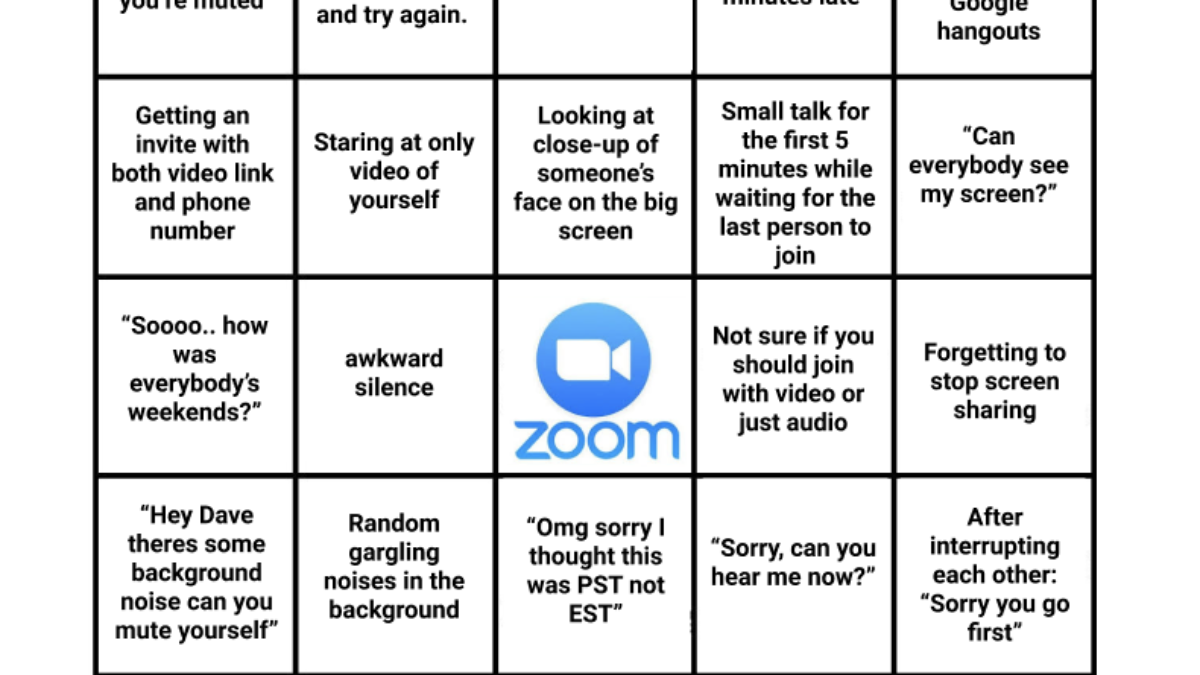
Bingo inspires employees to participate and pay close attention to virtual training sessions. Give participants a bingo board with a set number of accomplishments and action items. Bring your tools to Webex spaces. Install apps from a variety of business categories to unify your work with your team interactions. Play conference call bingo online during teleconferences and video conferences. See what bingo score you get and share with friends on Facebook. Tools such as Skype, WebEx, Zoom, and GoToMeeting all work great for screen sharing and teleconferencing. 3 Virtual Team Building Activities. Here are three fun and easy virtual team building activities and games: #1 “Little Known Facts About Me” The objective of this game is to connect with your team members on a personal level.
Update: I launched a “Fun Virtual Team-Building Activities” book that includes 18 easy games you can play on Zoom or Webex with your team (no special apps needed & includes downloadable templates). I’m donating some of the profits to COVID-19 efforts. Click here to learn more.
Virtual teams can feel very lonely.
These games use the platform’s features like video, chat and white boards to engage remote workers and facilitate virtual team bonding during online meetings and conference calls. These activities are also known as “MS Teams games.” These games are a subset of video conference call games and are similar to Zoom games and Webex games. Bingo is one of the more popular video conference games at the moment. That's because the game transitions well to the virtual setting and is conducive to both large and small groups. A Scavenger hunt is a game in which players have to run around in search of a particular article. This game can be played in teams or solo, and the larger the area you play it in, the more fun it gets. The aim of the game is to gather as many points as possible by finding the object before the rest of the players.
Remote employees are typically focused on their own silo, and rarely interact informally with their peers and managers like they would in a regular office.
Meetings in particular can feel very transactional and dry.
This is one big disadvantage of virtual teams – you lose what’s called the “water cooler” effect in a regular office, where team members bump into each other at the water cooler and talk about things unrelated to work.

Although such minor interactions can be trivial, their impact is quite significant on team performance. They have a tremendous positive effect on overall team morale and happiness.
So as a team leader, you should put in a concerted effort to create activities that help increase those team bonding factors.
The objective of those team building games
The objective of those virtual team building activities and games is to help you:
- build trust among your team members
- increase the level of cohesion and intimacy among your co-workers
- learn more about your team members on a personal and professional level
The activities are very simple to implement, yet have a huge return on investment for you and your team.
Who are those virtual team building activities for?
The following activities and games are designed for virtual teams of 4 or more individuals that are either just starting out (i.e., in the forming stage of team development) or have been working together for a while on a collaborative project (i.e., in the storming stage or beyond).
Those activities are especially helpful for teams that work closely together and interact multiple times throughout the week by using IM software, teleconferencing, and other virtual team tools.
The activities are not very applicable however, to teams that are working on short contractual work, such as a small team you hire through Upwork to design a website for you.
What you need for the virtual team building activities
You will need the following before conducting the virtual team building activities:
- Dedicated time: you need to dedicate some time either at the beginning or end of a virtual status meeting, or to set up a completely separate meeting focused on the activity itself
- A screen-sharing/ collaboration tool: to share your screen where everyone can see what you’re presenting on
- A conferencing tool: for folks to talk and listen in (like a regular phone teleconference or a web-based audio one)
- A main facilitator/ leader: who will help moderate the activity. Ideally, this would be the virtual team manager or project manager of the team
Tools such as Skype, WebEx, Zoom, and GoToMeeting all work great for screen sharing and teleconferencing.
3 Virtual Team Building Activities
Here are three fun and easy virtual team building activities and games:
#1 “Little Known Facts About Me”
The objective of this game is to connect with your team members on a personal level.
Most virtual teams don’t have a lot of time to mingle or chit-chat, so this game is great because your team members can open up and learn about each other’s backgrounds.
Here’s how it works:
Ask each team member to send 3 personal facts about them only to you as the facilitator. They should send this information to you a few days before the meeting so you have enough time to consolidate it.
It is important to tell the team members that those facts should not be related to their current job (and preferably not known to other members of the team) to make it more fun.
You will then enter those facts in a spreadsheet in random order. On the day of the meeting, you can then share the spreadsheet on a screen, and ask each team member to guess who that fact belongs to.
The spreadsheet will look something like this (I’m showing only 3 team members here for simplicity):
You would start with fact 1 at the top by reading it aloud and asking each of the team members to guess who they think that fact belongs to by speaking up. You’ll then type those guesses in the spreadsheet while sharing it on a screen where everyone can see.
Once that row is complete, you’ll move on to the next fact, and so on.
After filling in all of the rows, you can start at the top again and start filling in the right answers in the “Correct Answer” column. Asking the person with the associated fact to speak to it a bit is always amusing.
At the end, you as the facilitator can then tally up the scores of all the different team members to see who got the most guesses correctly.
This is a lot more fun than it actually sounds, because as you go through the facts, the guesses by the team are hilarious. And the facts you find out would reveal quite a bit about each team member’s background.
#2 “Video Roundtable”
The objective of this game is to increase the level of intimacy among your virtual team members.
Video conferencing is one of the least utilized features of remote teams, yet it is one of the most important to build trust.
I think people shy away from using video because they are just generally uncomfortable with it, or they’re just too busy to “fix themselves up” to be camera ready (and prefer to keep working in their PJs – like me 🙂 ).
However, video conferencing is a great way to increase the level of cohesion among your team.

In the Pyramid of Communication (where the higher up the pyramid, the more intimate the team is), video conferencing is only a couple of levels below the best form of communication: face-to-face.
Side note: I talk in-depth about the pyramid of communication and how it can help your team become more effective in my bestselling Udemy course about managing and influencing virtual teams (Get it for a steep discount on Udemy for a limited time by clicking here)
Here’s how this activity works:

Set aside 30 minutes to 1 hour for a “video roundtable” meeting every 2 to 4 weeks.
The goal of the meeting is to have everyone join a video conference and get an update from all the team members about what’s going well and what’s not.
This is not a detailed status update to discuss issues or risks (which should have their own separate meeting), but rather general feedback about how things are going with the team. In addition, everyone must share a single personal update about them to spice things up.
The key to making the activity work is two things:
First, explain to your team members ahead of time that it’s mandatory that everyone use video, and second, that every team member will get the chance to talk. This way, you’ll ensure that everyone has their web cams ready ahead of time, AND is prepared to give an update.
To add some structure to this, you can limit everyone’s responses to 6 minutes each, and have them answer three questions
- What’s one thing that’s been going great lately?
- What’s one thing that can be improved upon?
- What’s one thing that’s been going on with you personally?
A sample response could be:
1. “We’re doing great with the latest requirements document – we finished it ahead of schedule and the customer is happy. Big shout-out to Mike for helping us last week and walking through it in detail with our lead engineer.”
2. “One thing we could do better is be a bit more responsive in email. I realize we’re all very busy, but we had to wait 48 hours for a response from the Ops team, and this is going to affect us negatively in the long run.”
3. “A personal update is that I’m heading over with my wife and 3 kids to the Bahamas during my vacation next Friday. We’re all super-excited about it, and Charlie, my youngest, is looking forward to swimming with the dolphins.”
The idea is to avoid “presenting” anything. The focus should be on the person talking because it’s a Video Roundtable, and team members are free to ask or comment on any of the responses so that it feels like an open forum.
Having the video turned on is awesome because you can read everyone’s facial and body expressions as they speak, and it’s like you’re all sitting in a large conference room.
An optional idea is to ask everyone on video to bring along their favorite beverage – coffee, tea or soda – to the meeting so that it feels like a virtual coffee break.
#3 “Two Pictures”
The objective of this simple activity is to share visual images with your team members.
Here’s how the activity works:
Ask everyone to share two pictures (again, not related to work) about their own personal families or hobbies and spend 5 minutes talking about those pictures. Other team members are encouraged to ask them questions to learn more about their backgrounds.
There are two ways to play this game:
- Dedicate 30 minutes for a separate meeting where all team members share those 2 pictures in turn and talk about them.
- Dedicate 5 minutes at the beginning of a regular (unrelated) status meeting where only one person shares their pictures during that meeting, and the others can do so in subsequent meetings.
This is somewhat similar to the “Little Known Facts About Me” virtual team building activity, but it’s much simpler & quicker, and focuses on pictures instead of text.
The visual component makes it an incredible game that imprints memories among your team members.
If you don’t have time for any of the other games, this is definitely my favorite one because of its simplicity. It’s also the next best thing to having your own personalized office cubicle where you display personal memorabilia for your co-workers to see.
Here are some ideas for pictures you can share:
- Pictures of your family (including kids and pets)
- Picture of your home office or space where you usually work from (people love seeing this for some reason)
- Pictures of your last vacation
- Pictures of your hobbies
- Pictures of something interesting you found online (like a gadget you want to buy)
Conclusion
Those virtual team building activities are great to build trust and rapport among your team. You can try all of them, and then pick one that works for you and your team. You can even frequently play all 3 of them at different times during your team’s progression.
Here’s a quick recap:
- Little Known Facts About Me – a game where each member guesses published facts about their teammates
- Video Roundtable – a video conference where everyone has to use video and talk about general & personal feedback
- Two Pictures – an activity where everyone shares 2 pictures about anything unrelated to work, and spends 5 minutes talking to the team about them
I hope you found those virtual team building activities helpful!
Cheers,
Hassan
Games To Play On Webex
P.S. – [2020 Update] As a result of the Coronavirus pandemic, I launched a book called “Fun Virtual Team-Building Activities.“
The book includes 18 games and activities that help your team stay engaged while they work from home (no special tools or apps required).
It also includes downloadable spreadsheets and templates that save you time.
Webex Bingo Card
10% of the profits of the book will be donated to COVID-19 efforts
Fun Virtual Games For Work Meetings
> Click here to order “Fun Virtual-Team Building Activities”
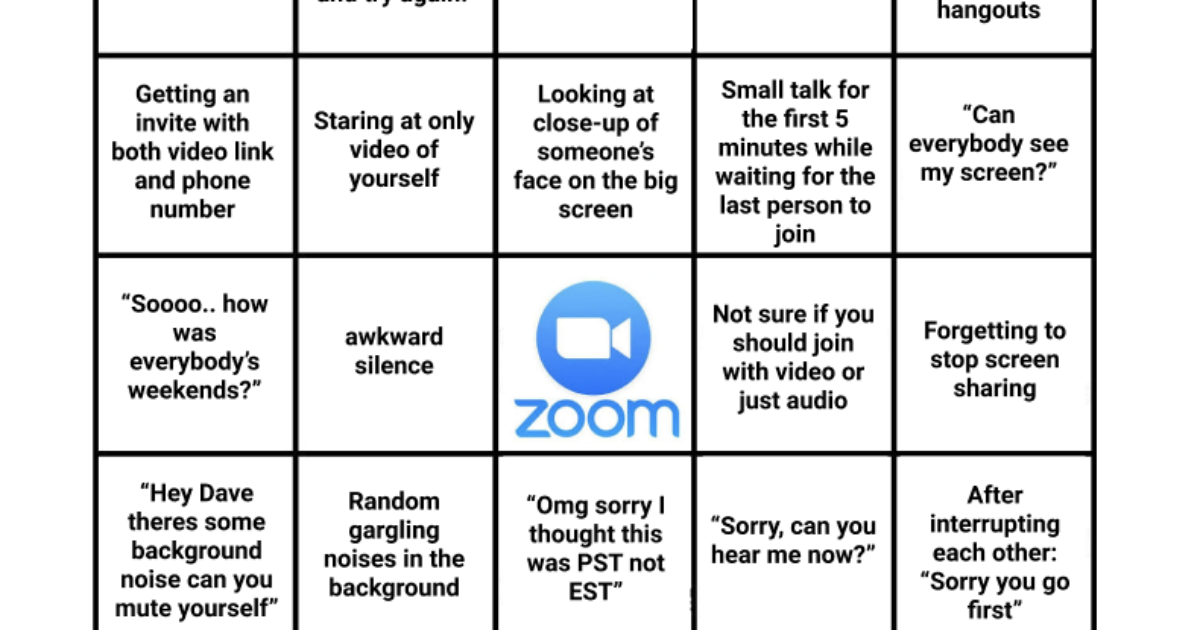
The work-at-home genie is out of the bottle, and we’re never going fully back to the office. So here’s a Conference Call Bingo game for you to weed out the new era bullshit.
Thanks to @inagfatt for this gem, and I’ll start by making a special rule.
If you hear the phrase shown bottom left, you win conference call bingo automatically.
“Hey guys sorry I have to hop off, you guys keep talking” should be everyone’s career credo.
I need to focus on what really matters, and this recurring meeting probably isn’t it.
That’s how Zoom rose above the conference call bingo game.
Zoom was born out of WebEx, which was founded in 1995 and acquired by Cisco for $3.2 billion in 2007.
Early WebEx engineer Eric Yuan founded Zoom in 2011 with help from early investment and advice from WebEx founder Subrah Iyar. Here’s how it played out:
– Zoom went live January 2013.
– Had 1 million users by May 2013 and 10 million by June 2014.
– Zoom raised $161 million over 7 rounds
– Went public April 2019 at a $9.2 billion IPO valuation.
– Zoom’s valuation jumped to $35 billion when pandemic lockdowns began in March 2020
– Zoom is now worth $118 billion.
Not bad for 10 years’ work.
And no question Zoom saved us in this era.
Zoom is genius really. It took something we all hate, and polished it up.
That’s the definition of tech disruption.
Webex Bingo Game Free
So we can rip Zoom all we want. And I’ll rip away for 2 reasons: (1) I hate conference calls almost as much as email, and (2) call culture worsens as micromanagers perfect Zoom meddling.
But conference call bullshit bingo and other jokes aside, Zoom is genius for 3 reasons:
1. Prove Remote Work Really Works:
Zoom made video calls and realtime back-and-forth screen sharing truly great. Zoom validates remote work by letting us prove we can be engaged even if we’re not sitting next to our teams. One silver lining of forced quarantines is proving once and for all that remote work really works.
2. Build Your Kid’s Youtube Dream:
Webex Bingo Game Download
My son wanted to start a Youtube channel last year, but only do it from an iPad and with screencast and audio. Until iOS upgraded screen record functionality, Zoom was the solution. And it still is because it’s easy and brought me a ton of joy supporting my son.
3. Bail On 1 Call Per Month:
Zoom is a giant success story about reinventing an utter commodity. They did this by stepping away from existing structure and looking at it fresh. And most jobs are a commodity. Unless you have the courage to step away periodically for a fresh look at reinventing yourself and your role.
So make it a habit to say that lower-left bingo card phrase on a call at least once a month, then bounce.
Too many daily routines are bullshit anyway, so use this tactic to focus on what matters to win your long game.
___
Related:
Virtual Bingo Webex
– Nights, Weekends & The 3 Phases Of Success
– The Bullshit Lie of ‘Thank God It’s Monday’
Webex Bingo Games
– 3 Ways To ‘Crush It’ Without Being An Asshole